WELCOME TO INTELLECT GOODWILL LLP

IP Protection in the Gaming Industry
Characters, Code and Virtual Assets
6/18/202610 min read
Patents and technological innovation in the gaming industry
The gaming industry is not only creative but also highly technological. Gaming companies regularly develop new systems, graphics engines, gameplay features, controllers, and online technologies. Some of these inventions may qualify for patent protection if they meet legal standards of novelty and innovation. Patents give creators exclusive rights over their inventions for a specific period, preventing competitors from using the same technology without permission. Large gaming companies often rely on patents to protect advanced gaming technologies and maintain a competitive advantage in the market. At the same time, patent protection in gaming must be balanced carefully because overly broad patents can sometimes limit competition and creativity within the industry.
Conclusion: Protecting creativity in a digital world
The gaming industry is built on imagination, technology, creativity, and innovation. Every successful game represents years of hard work by developers, artists, writers, designers, and programmers. From iconic characters and software code to virtual assets and digital marketplaces, intellectual property protection has become a necessary part of the gaming ecosystem.
Without proper legal safeguards, creators may face piracy, copying, unfair competition, and misuse of their work. Strong intellectual property protection not only protects gaming companies but also encourages developers to continue creating new and exciting experiences for players around the world. As technology continues to evolve and gaming becomes more connected with virtual economies and digital spaces, intellectual property law will play an even bigger role in shaping the future of the gaming industry. In many ways, protecting games today means protecting creativity itself.
This article has been authored by Ms. Bhumi Patel, Intern at Intellect Goodwill LLP, as part of our ongoing IP Awareness Series - Intellect Insights, aimed at simplifying complex intellectual property concepts for entrepreneurs, creators, and businesses.
The views expressed in this article are for informational purposes only and do not constitute legal advice. The content reflects the personal analysis of the author and not necessarily the views of Intellect Goodwill LLP.
Introduction: Gaming Is No Longer “Just a Game”
The gaming world has grown far beyond simple entertainment. What once started as arcade machines and basic console games has now turned into a massive global industry involving technology, creativity, competition, and digital business. Today, people do not just play games for fun; they stream them online, participate in esports tournaments, purchase virtual items, and even build careers around gaming. Behind every successful game are developers, designers, writers, programmers, artists, and companies who spend years creating something unique. Because so much effort and money go into making a game, protecting these creations has become extremely important.
This is where Intellectual Property (IP) law plays a major role. IP protection helps game creators protect their original work from being copied, stolen, or commercially misused. In the gaming industry, intellectual property can include characters, software code, music, graphics, logos, storylines, and even virtual items sold inside games. Without legal protection, developers may lose ownership over the very creations they worked hard to build.
Gaming Characters: More than just fictional figures
Many video game characters become instantly recognizable across the world. Some characters become so popular that they turn into global brands and are remembered for generations. Characters like Mario, Pikachu, Sonic the Hedgehog, and Lara Croft are not just part of games anymore; they have become cultural icons with massive commercial value. These characters are carefully designed with unique appearances, personalities, voices, and storylines that create a strong emotional connection with players.
To protect such creations, copyright law safeguards the artistic aspects of characters, including their visual design, animation, dialogues, and expressions. Trademark law also protects character names, symbols, and logos connected with the game. This ensures that no other company can unfairly use or imitate famous gaming identities for commercial benefit.
Courts have also recognized that fictional characters with unique features deserve independent legal protection. This idea has become increasingly important in the gaming industry because characters often represent the commercial identity of an entire game franchise.
Software Code: The Backbone of Every Video Game
Behind every smooth movement, mission, sound effect, or multiplayer interaction lies software code created by programmers. The code is what makes the game function properly. Developing game software requires technical expertise, creativity, and countless hours of work. Naturally, this code becomes one of the most valuable assets for gaming companies.
Under copyright law, software and computer programs are protected as literary works. This means that copying, modifying, or distributing game code without permission may amount to copyright infringement. Illegal downloading and piracy continue to be major concerns for the gaming industry because copied versions of games can spread very quickly on the internet.
The importance of protecting gaming software was clearly seen in Nintendo of America Inc. v. Atari Games Corp., 975 F.2d 832 (Fed. Cir. 1992). In this case, the court dealt with unauthorized copying of Nintendo’s security system code and emphasized that video game software deserves strong legal protection against misuse and piracy.
Indian laws protecting the gaming industry
The gaming industry in India is mainly protected through existing intellectual property laws such as the Copyright Act, 1957, the Trade Marks Act, 1999, the Patents Act, 1970, and the Information Technology Act, 2000. The Copyright Act protects important elements of video games including software code, graphics, music, animations, storylines, and audiovisual content. Under Sections 13 and 14 of the Copyright Act, creators receive exclusive rights over their original work, while Section 51 provides remedies against piracy and unauthorized copying. Trademark protection under the Trade Marks Act, 1999 helps gaming companies secure names, logos, symbols, and even famous gaming characters, preventing misuse and market confusion.
Apart from copyright and trademarks, the Patents Act, 1970 also protects innovative gaming technologies, controllers, graphics systems, and technical inventions, provided they satisfy the requirements under Sections 2(1)(j) and 2(1)(ja). However, Section 3(k) restricts patent protection for computer programs “per se.” Additionally, the Information Technology Act, 2000 plays an important role in dealing with hacking, cyber piracy, unauthorized access, and theft of gaming accounts or virtual assets. Although India still lacks specialized laws specifically dealing with virtual assets and digital ownership in gaming, the existing legal framework continues to provide significant protection to creators and gaming companies.
Modern gaming has introduced a completely new concept known as virtual assets. Players today spend real money on digital items such as skins, costumes, virtual currency, weapons, avatars, and collectibles. Some online games even allow players to buy virtual land or trade rare digital items with other players.
As these digital assets gain financial value, legal issues surrounding ownership and protection have also increased. Questions often arise about whether virtual items actually belong to players or remain the property of the gaming company. Cases involving hacked gaming accounts, stolen virtual items, and unauthorized sales of digital assets are becoming more common.With the rise of online multiplayer gaming, blockchain-based games, and metaverse platforms, virtual property rights are becoming a serious legal issue. Although laws in many countries are still developing in this area, intellectual property rights continue to play an important role in protecting digital gaming ecosystems.
Game Cloning and Unfair Imitation
Another major challenge faced by the gaming industry is game cloning. Sometimes developers copy successful games and release nearly identical versions with slight changes in appearance or gameplay. The purpose is usually to attract players and profits without investing in original creativity.Although copyright law does not protect general ideas, it does protect the original expression of those ideas. Therefore, copying specific elements such as artwork, visual layouts, characters, music, or gameplay presentation may result in copyright infringement.
An important case on this issue is Tetris Holding, LLC v. Xio Interactive, Inc., 863 F. Supp. 2d 394 (D.N.J. 2012). The court held that copying the unique visual appearance and gameplay elements of the famous game Tetris amounted to copyright infringement. The decision showed that original game designs and presentations can receive legal protection.

Patents and technological innovation in the gaming industry
The gaming industry is not only creative but also highly technological. Gaming companies regularly develop new systems, graphics engines, gameplay features, controllers, and online technologies. Some of these inventions may qualify for patent protection if they meet legal standards of novelty and innovation. Patents give creators exclusive rights over their inventions for a specific period, preventing competitors from using the same technology without permission. Large gaming companies often rely on patents to protect advanced gaming technologies and maintain a competitive advantage in the market. At the same time, patent protection in gaming must be balanced carefully because overly broad patents can sometimes limit competition and creativity within the industry.
Conclusion:Protecting creativity in a digital world
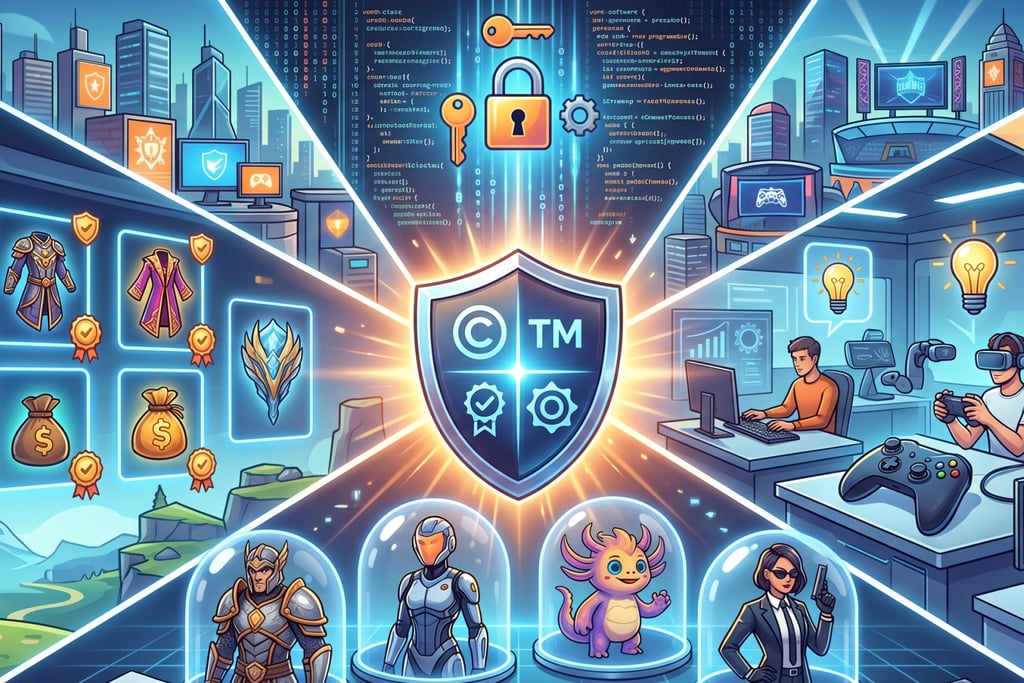
The gaming industry is built on imagination, technology, creativity, and innovation. Every successful game represents years of hard work by developers, artists, writers, designers, and programmers. From iconic characters and software code to virtual assets and digital marketplaces, intellectual property protection has become a necessary part of the gaming ecosystem.
Without proper legal safeguards, creators may face piracy, copying, unfair competition, and misuse of their work. Strong intellectual property protection not only protects gaming companies but also encourages developers to continue creating new and exciting experiences for players around the world. As technology continues to evolve and gaming becomes more connected with virtual economies and digital spaces, intellectual property law will play an even bigger role in shaping the future of the gaming industry. In many ways, protecting games today means protecting creativity itself.
This article has been authored by Ms. Bhumi Patel, Intern at Intellect Goodwill LLP, as part of our ongoing IP Awareness Series - Intellect Insights, aimed at simplifying complex intellectual property concepts for entrepreneurs, creators, and businesses.
The views expressed in this article are for informational purposes only and do not constitute legal advice. The content reflects the personal analysis of the author and not necessarily the views of Intellect Goodwill LLP.
Introduction: Gaming Is No Longer “Just a Game”
The gaming world has grown far beyond simple entertainment. What once started as arcade machines and basic console games has now turned into a massive global industry involving technology, creativity, competition, and digital business. Today, people do not just play games for fun; they stream them online, participate in esports tournaments, purchase virtual items, and even build careers around gaming. Behind every successful game are developers, designers, writers, programmers, artists, and companies who spend years creating something unique. Because so much effort and money go into making a game, protecting these creations has become extremely important.
This is where Intellectual Property (IP) law plays a major role. IP protection helps game creators protect their original work from being copied, stolen, or commercially misused. In the gaming industry, intellectual property can include characters, software code, music, graphics, logos, storylines, and even virtual items sold inside games. Without legal protection, developers may lose ownership over the very creations they worked hard to build.
Gaming Characters: More than just fictional figures
Many video game characters become instantly recognizable across the world. Some characters become so popular that they turn into global brands and are remembered for generations. Characters like Mario, Pikachu, Sonic the Hedgehog, and Lara Croft are not just part of games anymore; they have become cultural icons with massive commercial value. These characters are carefully designed with unique appearances, personalities, voices, and storylines that create a strong emotional connection with players.
To protect such creations, copyright law safeguards the artistic aspects of characters, including their visual design, animation, dialogues, and expressions. Trademark law also protects character names, symbols, and logos connected with the game. This ensures that no other company can unfairly use or imitate famous gaming identities for commercial benefit.
Courts have also recognized that fictional characters with unique features deserve independent legal protection. This idea has become increasingly important in the gaming industry because characters often represent the commercial identity of an entire game franchise.
Software Code: The Backbone of Every Video Game
Behind every smooth movement, mission, sound effect, or multiplayer interaction lies software code created by programmers. The code is what makes the game function properly. Developing game software requires technical expertise, creativity, and countless hours of work. Naturally, this code becomes one of the most valuable assets for gaming companies.
Under copyright law, software and computer programs are protected as literary works. This means that copying, modifying, or distributing game code without permission may amount to copyright infringement. Illegal downloading and piracy continue to be major concerns for the gaming industry because copied versions of games can spread very quickly on the internet.
The importance of protecting gaming software was clearly seen in Nintendo of America Inc. v. Atari Games Corp., 975 F.2d 832 (Fed. Cir. 1992). In this case, the court dealt with unauthorized copying of Nintendo’s security system code and emphasized that video game software deserves strong legal protection against misuse and piracy.
Indian laws protecting the gaming industry
The gaming industry in India is mainly protected through existing intellectual property laws such as the Copyright Act, 1957, the Trade Marks Act, 1999, the Patents Act, 1970, and the Information Technology Act, 2000. The Copyright Act protects important elements of video games including software code, graphics, music, animations, storylines, and audiovisual content. Under Sections 13 and 14 of the Copyright Act, creators receive exclusive rights over their original work, while Section 51 provides remedies against piracy and unauthorized copying. Trademark protection under the Trade Marks Act, 1999 helps gaming companies secure names, logos, symbols, and even famous gaming characters, preventing misuse and market confusion.
Apart from copyright and trademarks, the Patents Act, 1970 also protects innovative gaming technologies, controllers, graphics systems, and technical inventions, provided they satisfy the requirements under Sections 2(1)(j) and 2(1)(ja). However, Section 3(k) restricts patent protection for computer programs “per se.” Additionally, the Information Technology Act, 2000 plays an important role in dealing with hacking, cyber piracy, unauthorized access, and theft of gaming accounts or virtual assets. Although India still lacks specialized laws specifically dealing with virtual assets and digital ownership in gaming, the existing legal framework continues to provide significant protection to creators and gaming companies.
Modern gaming has introduced a completely new concept known as virtual assets. Players today spend real money on digital items such as skins, costumes, virtual currency, weapons, avatars, and collectibles. Some online games even allow players to buy virtual land or trade rare digital items with other players.
As these digital assets gain financial value, legal issues surrounding ownership and protection have also increased. Questions often arise about whether virtual items actually belong to players or remain the property of the gaming company. Cases involving hacked gaming accounts, stolen virtual items, and unauthorized sales of digital assets are becoming more common.With the rise of online multiplayer gaming, blockchain-based games, and metaverse platforms, virtual property rights are becoming a serious legal issue. Although laws in many countries are still developing in this area, intellectual property rights continue to play an important role in protecting digital gaming ecosystems.
Game Cloning and Unfair Imitation
Another major challenge faced by the gaming industry is game cloning. Sometimes developers copy successful games and release nearly identical versions with slight changes in appearance or gameplay. The purpose is usually to attract players and profits without investing in original creativity.Although copyright law does not protect general ideas, it does protect the original expression of those ideas. Therefore, copying specific elements such as artwork, visual layouts, characters, music, or gameplay presentation may result in copyright infringement.
An important case on this issue is Tetris Holding, LLC v. Xio Interactive, Inc., 863 F. Supp. 2d 394 (D.N.J. 2012). The court held that copying the unique visual appearance and gameplay elements of the famous game Tetris amounted to copyright infringement. The decision showed that original game designs and presentations can receive legal protection.

GET IN TOUCH WITH US
Address
69, Patrakar Colony, Indore, Madhya Pradesh - 452018