WELCOME TO INTELLECT GOODWILL LLP

Patent Evergreening in Pharmaceuticals
Innovation or Abuse?
6/18/202610 min read


THE DARK SIDE OF EVERGREENING
On the other hand, critics view patent evergreening as a misuse of the patent system. They argue that many pharmaceutical companies rely on legal and technical loopholes to maintain monopolies over profitable drugs for longer periods than originally intended. Instead of investing in genuinely new cures, companies may repeatedly seek patents for minor alterations that do not significantly improve the therapeutic value of the medicine. This delays the entry of generic manufacturers who could otherwise offer the same medicines at much lower prices. As a result, patients continue to pay high prices for essential drugs, sometimes for many additional years. In developing nations where healthcare resources are already limited, such practices can have serious consequences for public health.
THE INDIAN PATENT REGIME AND ITS UNIQUE APPROACH
The patent system in India tries to maintain a balance between encouraging innovation and protecting public health. The Patents Act, 1970 grants protection only to inventions that are new, inventive, and capable of industrial application. Unlike some countries that allow broad pharmaceutical patents, Indian law follows a stricter approach to prevent misuse of patent rights.
One of the most important provisions is Section 3(d) of the Patents Act, 1970, which prevents companies from obtaining patents for minor modifications of existing drugs unless they show enhanced therapeutic efficacy. This provision was introduced mainly to stop patent evergreening and to ensure that only genuine innovations receive protection.
Further, Sections 2(1)(j) and 2(1)(ja) define what qualifies as an invention and an inventive step, ensuring that obvious or insignificant changes do not get patented. Another significant safeguard is compulsory licensing under Section 84, which allows the government to permit the manufacture of patented medicines in situations involving public interest and lack of affordability.
THE LANDMARK NOVARTIS JUDGEMENT
The importance of Section 3(d) became widely recognized after the landmark case of Novartis AG v. Union of India (2013) 6 SCC 1. In this case, the pharmaceutical company sought a patent for a modified version of a cancer drug. The company argued that the modified form had better properties compared to the earlier version. However, the Supreme Court of India refused to grant the patent because the company failed to prove enhanced therapeutic efficacy as required under Section 3(d). The Court made it clear that patent protection should only be available for genuine inventions that provide real medical benefits, and not for minor changes designed to extend monopoly rights. This judgment is considered one of the most significant decisions in Indian patent law and is often praised globally for protecting access to affordable medicines.
BALANCING PATENT RIGHTS AND PUBLIC INTEREST
Another important decision came in F. Hoffmann-La Roche Ltd. v. Cipla Ltd. 2009 (40) PTC 125 (Del), where the court emphasized the need to balance patent rights with public interest. The judiciary recognized that while innovation deserves protection, public health considerations cannot be ignored, especially in cases involving life-saving medicines. These decisions reflect the broader philosophy of Indian patent law, which attempts to ensure that intellectual property rights do not override the larger social objective of affordable healthcare.
IMPACT ON PUBLIC HEALTH AND GENERIC MEDICINES
The impact of patent evergreening extends far beyond legal debates. Its effects are deeply felt in public health systems and pharmaceutical markets. When generic medicines are delayed, competition in the market is reduced, allowing one company to dominate the sale of a drug for an extended period. This usually leads to higher prices and limited accessibility. For patients suffering from chronic or life-threatening diseases, the difference between an affordable generic medicine and an expensive patented drug can determine whether treatment is possible at all. In countries with lower income levels, prolonged monopolies over medicines may place a heavy burden not only on patients but also on governments and healthcare institutions responsible for providing public healthcare services.
PRACTICAL CHALLENGES IN ENFORCEMENT
Even with strong legal safeguards, implementing these principles remains difficult in practice. Patent disputes often involve highly technical scientific arguments that require specialized expertise to evaluate. Determining whether a modification truly enhances therapeutic efficacy can be complex and subjective. Pharmaceutical companies usually possess vast financial and legal resources, enabling them to pursue lengthy litigation. As a result, patent authorities and courts must carefully examine each case to ensure that the law is applied fairly and consistently.
CONCLUSION: FINDING THE RIGHT BALANCE
Patent evergreening ultimately represents a conflict between commercial interests and public welfare. While pharmaceutical companies seek to protect their investments and maximize profits, society also has a legitimate interest in ensuring that essential medicines remain affordable and accessible. India has attempted to strike this balance through provisions like Section 3(d) and through progressive judicial interpretation. The Indian approach demonstrates that patent law should not merely serve private monopoly interests but should also reflect broader public health concerns.
In the end, the true purpose of the patent system is to promote innovation that benefits society. If patents are used merely as tools to extend monopolies without meaningful medical advancement, the system risks losing its legitimacy. Genuine innovation deserves protection and encouragement, but abuse of legal rights at the cost of public health cannot be justified. The ongoing debate surrounding patent evergreening therefore highlights the need for a patent regime that supports both scientific progress and the fundamental human need for accessible healthcare.
In today’s world, access to affordable medicines is not merely a matter of business or trade; it is closely connected to the right to health and human dignity. Medicines are essential for survival, and in countries like India, where a large section of the population depends on low-cost healthcare, the affordability of drugs becomes extremely important. At the same time, the pharmaceutical industry also plays a vital role in society. Developing a new medicine is a long, expensive, and risky process that involves scientific research, clinical trials, regulatory approvals, and huge financial investment. To reward such efforts and encourage further innovation, patent laws grant pharmaceutical companies exclusive rights over their inventions for a limited period, usually twenty years. During this time, other companies cannot manufacture or sell the same drug without permission. However, over the years, concerns have emerged regarding the misuse of this protection through a practice commonly known as patent evergreening.
UNDERSTANDING PATENT EVERGREENING
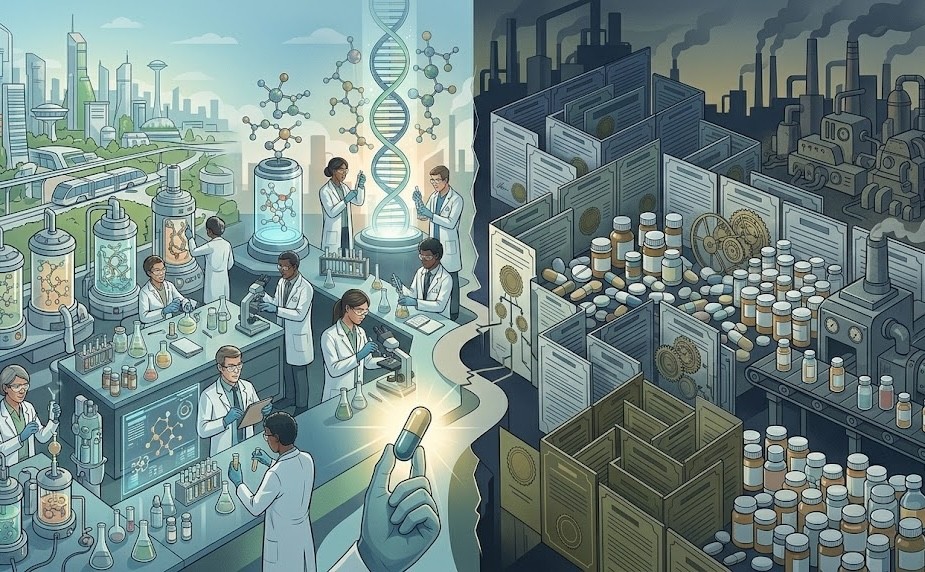
Patent evergreening refers to the strategy where pharmaceutical companies attempt to extend the life of a patent by making minor modifications to existing drugs instead of creating genuinely new inventions. These changes may include altering the dosage form, changing the method of administration, creating a new salt or crystalline form, or combining existing medicines in a slightly different manner. While such modifications may appear innovative on paper, critics argue that many of them do not offer any substantial therapeutic improvement to patients. Instead, they are often aimed at extending market exclusivity and delaying the entry of cheaper generic medicines into the market.
INNOVATION OR MONOPOLY? - THE CORE DEBATE
This issue has created a major debate between innovation and abuse. Pharmaceutical companies strongly defend incremental innovation by arguing that medical advancement does not always happen through revolutionary discoveries. According to them, even small improvements can make medicines safer, more effective, or easier for patients to consume. A modified drug may reduce side effects, improve stability, increase shelf life, or make treatment more convenient for patients who need long-term medication. Companies argue that such developments require continued scientific effort and investment, and therefore deserve protection under patent law. From their perspective, denying patents for incremental improvements may discourage companies from investing in research aimed at refining existing medicines.
This article has been authored by Ms. Bhumi Patel, Intern at Intellect Goodwill LLP, as part of our ongoing IP Awareness Series - Intellect Insights, aimed at simplifying complex intellectual property concepts for entrepreneurs, creators, and businesses.
The views expressed in this article are for informational purposes only and do not constitute legal advice. The content reflects the personal analysis of the author and not necessarily the views of Intellect Goodwill LLP.

The Dark Side Of Evergreening
On the other hand, critics view patent evergreening as a misuse of the patent system. They argue that many pharmaceutical companies rely on legal and technical loopholes to maintain monopolies over profitable drugs for longer periods than originally intended. Instead of investing in genuinely new cures, companies may repeatedly seek patents for minor alterations that do not significantly improve the therapeutic value of the medicine. This delays the entry of generic manufacturers who could otherwise offer the same medicines at much lower prices. As a result, patients continue to pay high prices for essential drugs, sometimes for many additional years. In developing nations where healthcare resources are already limited, such practices can have serious consequences for public health.
The Indian Patent Regime and Its Unique Approach
The patent system in India tries to maintain a balance between encouraging innovation and protecting public health. The Patents Act, 1970 grants protection only to inventions that are new, inventive, and capable of industrial application. Unlike some countries that allow broad pharmaceutical patents, Indian law follows a stricter approach to prevent misuse of patent rights.
One of the most important provisions is Section 3(d) of the Patents Act, 1970, which prevents companies from obtaining patents for minor modifications of existing drugs unless they show enhanced therapeutic efficacy. This provision was introduced mainly to stop patent evergreening and to ensure that only genuine innovations receive protection.
Further, Sections 2(1)(j) and 2(1)(ja) define what qualifies as an invention and an inventive step, ensuring that obvious or insignificant changes do not get patented. Another significant safeguard is compulsory licensing under Section 84, which allows the government to permit the manufacture of patented medicines in situations involving public interest and lack of affordability.
The Landmark Novartis Judgement
The importance of Section 3(d) became widely recognized after the landmark case of Novartis AG v. Union of India (2013) 6 SCC 1. In this case, the pharmaceutical company sought a patent for a modified version of a cancer drug. The company argued that the modified form had better properties compared to the earlier version. However, the Supreme Court of India refused to grant the patent because the company failed to prove enhanced therapeutic efficacy as required under Section 3(d). The Court made it clear that patent protection should only be available for genuine inventions that provide real medical benefits, and not for minor changes designed to extend monopoly rights. This judgment is considered one of the most significant decisions in Indian patent law and is often praised globally for protecting access to affordable medicines.
Balancing Patent Rights and Public Interest
Another important decision came in F. Hoffmann-La Roche Ltd. v. Cipla Ltd. 2009 (40) PTC 125 (Del), where the court emphasized the need to balance patent rights with public interest. The judiciary recognized that while innovation deserves protection, public health considerations cannot be ignored, especially in cases involving life-saving medicines. These decisions reflect the broader philosophy of Indian patent law, which attempts to ensure that intellectual property rights do not override the larger social objective of affordable healthcare.
Impact on Public health and Generic Medicines
The impact of patent evergreening extends far beyond legal debates. Its effects are deeply felt in public health systems and pharmaceutical markets. When generic medicines are delayed, competition in the market is reduced, allowing one company to dominate the sale of a drug for an extended period. This usually leads to higher prices and limited accessibility. For patients suffering from chronic or life-threatening diseases, the difference between an affordable generic medicine and an expensive patented drug can determine whether treatment is possible at all. In countries with lower income levels, prolonged monopolies over medicines may place a heavy burden not only on patients but also on governments and healthcare institutions responsible for providing public healthcare services.
Practical Challenges in Enforcement
Even with strong legal safeguards, implementing these principles remains difficult in practice. Patent disputes often involve highly technical scientific arguments that require specialized expertise to evaluate. Determining whether a modification truly enhances therapeutic efficacy can be complex and subjective. Pharmaceutical companies usually possess vast financial and legal resources, enabling them to pursue lengthy litigation. As a result, patent authorities and courts must carefully examine each case to ensure that the law is applied fairly and consistently.
Conclusion: Finding The Right Balance
Patent evergreening ultimately represents a conflict between commercial interests and public welfare. While pharmaceutical companies seek to protect their investments and maximize profits, society also has a legitimate interest in ensuring that essential medicines remain affordable and accessible. India has attempted to strike this balance through provisions like Section 3(d) and through progressive judicial interpretation. The Indian approach demonstrates that patent law should not merely serve private monopoly interests but should also reflect broader public health concerns.
In the end, the true purpose of the patent system is to promote innovation that benefits society. If patents are used merely as tools to extend monopolies without meaningful medical advancement, the system risks losing its legitimacy. Genuine innovation deserves protection and encouragement, but abuse of legal rights at the cost of public health cannot be justified. The ongoing debate surrounding patent evergreening therefore highlights the need for a patent regime that supports both scientific progress and the fundamental human need for accessible healthcare.
In today’s world, access to affordable medicines is not merely a matter of business or trade; it is closely connected to the right to health and human dignity. Medicines are essential for survival, and in countries like India, where a large section of the population depends on low-cost healthcare, the affordability of drugs becomes extremely important. At the same time, the pharmaceutical industry also plays a vital role in society. Developing a new medicine is a long, expensive, and risky process that involves scientific research, clinical trials, regulatory approvals, and huge financial investment. To reward such efforts and encourage further innovation, patent laws grant pharmaceutical companies exclusive rights over their inventions for a limited period, usually twenty years. During this time, other companies cannot manufacture or sell the same drug without permission. However, over the years, concerns have emerged regarding the misuse of this protection through a practice commonly known as patent evergreening.
Patent evergreening refers to the strategy where pharmaceutical companies attempt to extend the life of a patent by making minor modifications to existing drugs instead of creating genuinely new inventions. These changes may include altering the dosage form, changing the method of administration, creating a new salt or crystalline form, or combining existing medicines in a slightly different manner. While such modifications may appear innovative on paper, critics argue that many of them do not offer any substantial therapeutic improvement to patients. Instead, they are often aimed at extending market exclusivity and delaying the entry of cheaper generic medicines into the market.
Innovation Or Monopoly? - The Core Debate
This issue has created a major debate between innovation and abuse. Pharmaceutical companies strongly defend incremental innovation by arguing that medical advancement does not always happen through revolutionary discoveries. According to them, even small improvements can make medicines safer, more effective, or easier for patients to consume. A modified drug may reduce side effects, improve stability, increase shelf life, or make treatment more convenient for patients who need long-term medication. Companies argue that such developments require continued scientific effort and investment, and therefore deserve protection under patent law. From their perspective, denying patents for incremental improvements may discourage companies from investing in research aimed at refining existing medicines.

This article has been authored by Ms. Bhumi Patel, Intern at Intellect Goodwill LLP, as part of our ongoing IP Awareness Series - Intellect Insights, aimed at simplifying complex intellectual property concepts for entrepreneurs, creators, and businesses.
The views expressed in this article are for informational purposes only and do not constitute legal advice. The content reflects the personal analysis of the author and not necessarily the views of Intellect Goodwill LLP.
Understanding Patent Evergreening
GET IN TOUCH WITH US
Address
69, Patrakar Colony, Indore, Madhya Pradesh - 452018