WELCOME TO INTELLECT GOODWILL LLP

Patent vs. Copyright for Software
Patent vs. Copyright for Software: What Protects What?
12/8/20254 min read
Patent vs. Copyright for Software: What Protects What?
In today’s software-driven world, intellectual property protection is more important than ever. Whether you're an app developer, a startup founder, or a tech-savvy entrepreneur, understanding how to protect your digital creations can make the difference between success and costly infringement battles. Software innovations involve many layers of protection. Patents and copyrights each cover different parts of a software product. Broadly speaking, patents grant exclusive rights over new technical inventions (for example, a novel algorithm or process), while copyright protects the original expression of the software (for example, the source code and user interface). Patents guard the underlying functionality of software, whereas copyright protects the literal code and design elements. Understanding the difference helps creators decide how to safeguard their work. Two major forms of IP protection come into play for software: patents and copyrights. While both serve to safeguard innovations, they protect very different aspects of software. Misunderstanding the distinction can lead to under-protection or worse, infringement.
Let’s break it down.
🔍 What Does Copyright Protect in Software?
Think of copyright as the protection for the creative expression of software.
When a developer writes code, designs a graphical interface, or prepares documentation, that creative output is automatically protected under copyright law (in most jurisdictions). There is no need to register for copyright protection to exist—though registration can be beneficial for legal enforcement.
What it protects:
Source code and object code
UI/UX design elements
Original screen displays
Software documentation
Multimedia elements like sounds or graphics
What it does not protect:
Ideas
Algorithms
Functional processes
Programming languages or interfaces
📌 Example: If you develop a fitness app and write all the code yourself, that code is protected by copyright. But if someone builds a similar app using different code, copyright won’t help you stop them, unless they copied your code verbatim.
💡 What Does a Patent Protect in Software?
Unlike copyright, a patent doesn’t protect how your software looks or how the code is written. Instead, it protects how it works, the inventive technical processes, methods, or systems behind your software.
To be patentable, your invention must be:
Novel (new)
Non-obvious (not something a skilled developer would easily come up with)
Useful (serves a practical function)
What it protects:
Unique algorithms or computational methods
Software-based technical solutions to real-world problems
Data processing techniques
System architectures
What it does not protect:
Abstract ideas
Mathematical formulas
Code or UI elements (those fall under copyright)
📌 Example: Google’s PageRank algorithm was patented because it introduced a novel method for ranking web pages based on their link structures. That idea went far beyond the code, it was a new way of solving a technical problem.
⚖️ Software Patents and Section 3(k) in India
In India, Section 3(k) of the Patents Act, 1970 explicitly excludes “a mathematical or business method or a computer program per se or algorithms” from being patented.
This clause reflects the Indian legislature’s intent to prevent monopolies over abstract software ideas that lack technical application.
However, Indian courts and the Patent Office have interpreted Section 3(k) to mean that software combined with a novel technical effect, such as improving machine performance or enabling a new technical process - may be patentable.
✅ So, in India, software can be patented if it:
Demonstrates a technical effect or improvement (e.g., enhanced security, reduced hardware load, etc.)
Is not just a program “per se,” but part of a larger technical system or method
🚫 Not patentable if:
It’s just code performing a business task
It lacks a technical contribution
It is merely an automation of a known manual process
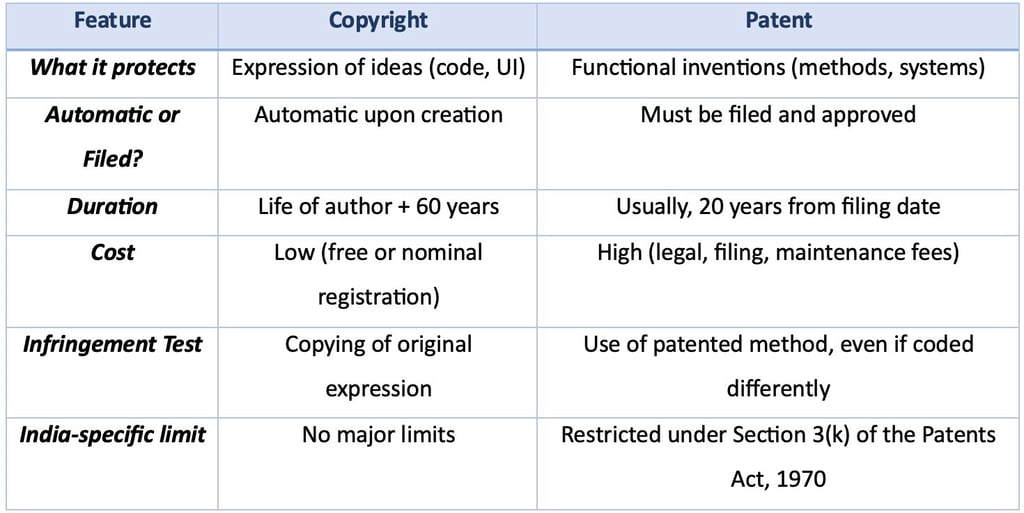
📊 Key Differences at a Glance

🧩 How They Work Together
One of the most common misconceptions is that you have to choose between a patent or copyright. But in practice, both can, and often should be used together.
Let’s say you’ve developed a unique data encryption method and implemented it in a software product:
You can copyright the source code, documentation, and visual design.
You can patent the encryption algorithm and the process that powers it.
This layered approach ensures that both your implementation (the "how") and your expression (the "what") are legally protected.
🎯 Why It Matters
Failing to secure proper protection can expose your business to theft, cloning, and competitive disadvantage. Meanwhile, overreaching, trying to patent abstract ideas or asserting copyright over functional methods, can get your claims rejected or invalidated.
Understanding the distinction helps:
Developers ensure their work is properly protected.
Startups build IP portfolios that add valuation.
Investors assess the defensibility of tech products.
Businesses avoid costly infringement pitfalls.
🧠 Takeaway
Think of copyright as guarding the expression of your software, the code you write and the look of your interface.
Think of patents as protecting the innovation inside, the processes, systems, and methods that make your software function in a new and useful way.
Knowing which applies to your creation, and when to use both, can help you safeguard your software more effectively and strategically.
This article has been authored by Manisha Chakravarti, Associate at Intellect Goodwill LLP under the able guidance of Adv. Manish Nair Sir (Advocate, Madhya Pradesh High Court), as part of our ongoing IP Awareness Series - Intellect Insights, aimed at simplifying complex intellectual property concepts for entrepreneurs, creators, and businesses.
The views expressed in this article are for informational purposes only and do not constitute legal advice. The content reflects the personal analysis of the author and not necessarily the views of Intellect Goodwill LLP.
GET IN TOUCH WITH US
Address
69, Patrakar Colony, Indore, Madhya Pradesh - 452018